5 Signs it’s Time for a Difficult Teacher Evaluation Conversation

My path in education did not begin with a plan to become a principal.
I started as a teacher and coach, and I spent my early years in education in roles that taught me how much leadership matters. At one point, I thought my future would be in athletics. I went back to school with the goal of becoming the first female athletic director in Texas, back before that was something you ever saw. But the principal I worked with encouraged me to spend a year in the building first. He told me he thought I would make a strong principal.
I agreed to try it for a year. I fell in love with it immediately.
What drew me in was the reach. In campus leadership, you still care about individual students, but you also get the chance to support teachers, influence instruction across classrooms, and impact even more kids. That part of the work stayed with me. It still does.
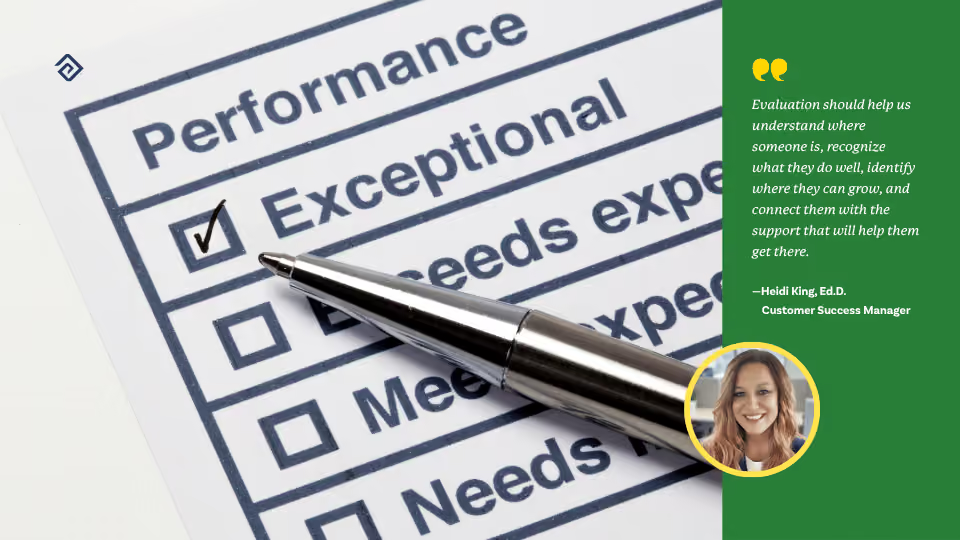
I see teacher evaluations not as a compliance task, but instead as one of the clearest ways school leaders can help teachers grow and make sure students are getting what they need.
That is why being in classrooms matters so much to me. You cannot lead instruction from behind a desk. The more you are in classrooms, the more you understand what is happening on your campus, the more trust you build with teachers, and the more credibility you have when it is time to give feedback.
If you do not start your day in the halls and classrooms, it is too easy to get stuck in the office and miss the heart of the work. Just as importantly, those visits create opportunities to learn, spot strong practice, and help great teaching spread.

Why These Conversations Matter
Difficult evaluation conversations are not optional. They are crucial because students do not get that time back.
A struggling teacher can affect instruction, student engagement, and the learning environment. That cannot be something we avoid just because the conversation feels uncomfortable.
One question helps cut through the hesitation: Would I want my own child sitting in that classroom? If the honest answer is no, then no child should be sitting in that classroom without intervention.
I think many school leaders hesitate because most people in education have big hearts. We want to support people. We want to encourage them. We assume everyone came into this profession because they care about kids, and in many cases they did. That is exactly why these conversations can feel heavy. But avoiding them does not help the teacher, and it certainly does not help the students.
What does help is remembering that these conversations should never come out of nowhere. A difficult conversation should not be a surprise.
If a leader is in classrooms regularly, giving feedback often, and providing support along the way, then even the hard conversations become clearer and more constructive. Tough conversations get a lot easier when the teacher already knows what the concern is and has had opportunities and time to address it.
These Should Never Be Spring-Only Conversations
One of the most important things I would tell any principal is this: these conversations are not supposed to begin in the spring.
Yes, spring is often when formal evaluations happen. Depending on the district or state, that may be when leaders are trying to complete observations and make staffing decisions before the year ends. But concerns about instruction, engagement, structure, or expectations should be addressed all year long.
When leaders wait too long, they lose the chance to help someone improve.
You cannot show up in the spring and suddenly bring up something you noticed in the fall if you never addressed it at the time. That teacher could have spent months growing. They could have shadowed another teacher, worked with a mentor, had someone model for them, or tried new strategies with support. Delaying the conversation does not make it easier; it simply reduces the time available for growth.
That is why immediate, consistent feedback matters. Not emotional reactions. Not “gotcha” moments. Just honest communication, given in time for it to make a difference.
The Five Signals
Over the years, there are a few patterns I learned to pay especially close attention to. None of these are about catching a teacher on one bad day. Teachers are human. They are allowed to have an off day, just like students are. What matters is whether you are seeing a pattern. That is another reason leaders need to be in classrooms often enough to know the difference between a rough day and a real concern.
Here are five signals that tell me it is time for a difficult teacher evaluation conversation.
1. The same instructional issues keep showing up
The first signal is persistence.
If I walk into a classroom multiple times and keep seeing the same instructional issue, that tells me it is time to address it directly. Maybe the lesson has no clear objective. Maybe it meanders. Maybe there is no real check for understanding. Maybe instruction lacks purpose or structure. If those same issues keep surfacing in walkthroughs, observations, and ordinary moments when you happen to be in the room, it is no longer a one-off concern. It is a pattern.
And when something is persistent, it deserves a real conversation.
2. Student engagement is consistently low
Low engagement is another major signal because disengaged students are rarely learning at the level they could be.
If students are always off task, checked out, or clearly uninterested, that tells you something important about what is happening instructionally. There are only so many minutes in a class period and only so many days in a school year. If students are sitting through instruction without engaging in it, we are wasting their time. We are wasting the teacher’s time too.
This does not mean every classroom has to look the same. It does mean students should be mentally present in the learning. If they are not, leaders need to ask why.
3. The classroom feels unstructured or chaotic
I want to be clear here; noise is not the problem.
Activity can be wonderful. Productive movement can be wonderful. Good classrooms are not always quiet classrooms. But there is a difference between active learning and unstructured chaos. When a classroom has no predictable routines, constant disruptions, or a teacher whose responses are inconsistent from one day to the next, students feel it immediately. Students need structure. Adults need structure too. Consistency is what allows them to focus and feel secure in the environment.
When that consistency is missing, the conversation cannot wait forever.
4. Expectations are not being met
Another clear signal is when a teacher is falling below district, campus, or instructional expectations.
Sometimes that shows up in lesson planning. Sometimes it shows up in failure to follow a campus methodology. A big one for me is differentiation. We cannot teach every student the exact same way and assume we have done our job. Students learn differently. They come in with different needs, strengths, and levels of readiness. If a teacher is not adjusting instruction to meet those needs, then students are not getting what they deserve.
This is one of those areas where a leader has to be very honest. If the expectations have been made clear and they are still not met, that requires follow-through.
5. Concerns are coming from outside the classroom
The fifth signal is when concerns start coming to you from other people.
That might be another teacher. It might be students. It might be parents. If you are visible on your campus, people will tell you what they are seeing and hearing. When that starts happening, it is time to talk with the teacher. Not based on gossip, but based on fairness and transparency. If others are raising concerns, the teacher deserves to know what is being said and to have a chance to respond.
Sometimes the right opening is simple: This is what I’m hearing. Help me understand why I’m hearing it. That conversation matters because outside concerns are often a sign that the issue is no longer contained.

When It Stops Being Coaching and Becomes Formal
A lot of issues can start as coaching conversations.
In fact, that is often where they should begin. But there comes a point when the issue has been discussed, expectations have been made clear, support has been offered, and the same concerns continue. That is when the conversation needs to become more formal.
Documentation is critical here.
If you have been doing regular walkthroughs, you have the record. You can point back to specific moments and say: On this date, we discussed this. Here was the expectation. Here is what I needed to see next time. That kind of clarity matters for everyone. It protects the process, but more importantly, it gives the teacher a fair and specific understanding of where things stand.
The goal is never to trap someone. The goal is to be clear enough that no one is confused about the concern, the support, or the next step. Leaders should absolutely give people the support and opportunity to grow. But if that growth is not happening, and students are continuing to be affected, there is still a responsibility to act. Supporting teachers matters. So does protecting student learning.
Growth Has to Be Done With Teachers, Not To Them
One of the biggest mistakes leaders can make is treating evaluations as something done to teachers instead of with them.
Most teachers want to improve. They care about students. They care about their subject. They want to do this work well. For that growth to happen, teachers also need to feel safe enough to be honest about where they are struggling. If leaders want real improvement, they have to create the kind of environment where people can be open, reflective, and willing to learn.
So, when a difficult conversation becomes necessary, I believe leaders must frame it as an opportunity for growth, not just a statement of failure. That does not mean softening the truth but rather being honest while still being supportive.
That starts with calm, consistent leadership that includes:
- Asking questions to understand whether something deeper is going on
- Showing the teacher what you are seeing
- Giving them something concrete to work with
- Offering walkthroughs in other classrooms
- Pairing them with a strong teacher
- Providing resources, modeling, or time to observe someone else’s practice
The point is not just to say, “This is not working.” The point is to help them see what better can look like. That is why if leaders are not in classrooms enough, not collaborating enough, or not providing resources for growth, then we are the ones falling short. That responsibility belongs to us too.
What Good Leadership Creates
When difficult evaluation conversations are handled well, the impact on school culture is enormous. It changes everything.
Schools become stronger when everyone is focused on the same goal and open to learning how to get there. Teachers can feel when evaluation is only about compliance, and they can feel when it is actually about growth. When leaders approach these conversations with consistency, clarity, and a real belief in development, people respond differently. The culture becomes more honest, more collaborative, and more energized.
That kind of culture is more fun, too. Truly. Teachers should be able to try new things, keep growing, and feel passionate about their work. That is much more likely to happen when evaluation is treated as a tool for improvement rather than a box to check.
For me, that is one of the best parts of leadership. It is the kind of work that fills your bucket.
The Tone Starts at the Top
If there is one thing I would want school leaders to remember, it is this: you set the tone for what evaluation means on your campus.
If you treat it like a compliance exercise, that is all it will ever be. But if you treat it like a tool for growth, a way to strengthen instruction, support teachers, and make sure students are getting what they need, then it becomes something much more meaningful.
That is how I have always tried to see it.
Evaluation is not just about accountability. It is about instructional leadership. It is about addressing concerns in time for them to matter. It is about making sure no one falls through the cracks. And above all, it is about doing what is right for kids.

More Great Content
We know you'll love